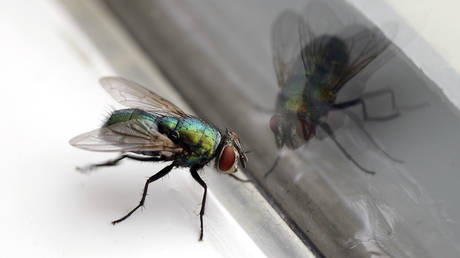
A complete digital copy of a fruit fly’s brain has been uploaded to a simulated environment and has been seen exhibiting natural behavior
A Silicon Valley startup has announced what it describes as the first “multi-behavior brain upload” after creating a complete digital replica of a fruit fly’s brain that controls a virtual body in a simulated environment.
The achievement, unveiled last week by Eon Systems, represents a significant leap beyond conventional AI.
Unlike AI systems that learn behaviors through training, the virtual fly’s actions, which include walking, grooming, and foraging entirely on its own, emerge from a neuron-by-neuron copy of a real biological brain.
“This is not an animation. It is not a reinforcement learning policy mimicking biology,” Eon co-founder Dr. Alex Wissner-Gross said in a social media post announcing the breakthrough. “It is a copy of a biological brain, wired neuron-to-neuron from electron microscopy data, running in simulation, making a body move.”
The feat builds on landmark research from 2024, when an international collaboration mapped the entire connectome of an adult fruit fly – every one of its roughly 140,000 neurons and 50 million synaptic connections. Eon senior scientist Philip Shiu co-authored a Nature paper showing that a computational model built from this wiring diagram could predict actual fly motor behavior with 95% accuracy.
However, the model was effectively a brain with no body to command. Eon has now closed the loop, integrating the digital brain with a physics-simulated fly body using Google DeepMind’s MuJoCo engine.
Sensory inputs from the virtual environment flow into the emulated brain, neural activity propagates through its complete connectome, and motor commands drive the simulated body’s movements. The digital creature’s behaviors arise from its own circuit dynamics, instead of programmed instructions.
Eon CEO Michael Andregg said the uploaded fly achieves 91% behavioral accuracy using only the connectome’s wiring, simple neuron models, and “no hand-tuning, no additional learning algorithms.”
The Eon team is now gathering data to attempt a complete mouse brain emulation – roughly 70 million neurons, 560 times the fly’s scale. Beyond that, the team ultimately aims to attempt an entire human brain upload.
“The ghost is no longer in the machine. The machine is becoming the ghost,” Wissner-Gross said.