Illegal logging, huge decommissioning costs and even ecological damage plague the supposedly ‘green’ generators
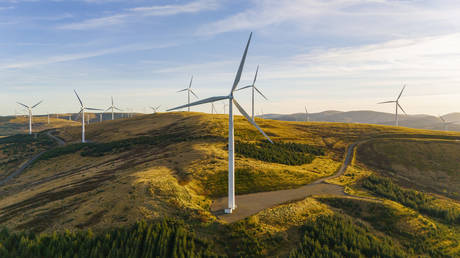
They may appear to be innocuous – even elegant – on the landscape as they collect power from the currents, but wind turbines have their own set of problems that environmentalists wish to ignore due to their eco-virtue-signaling.
As environmentalists look at a sprawling field of wind turbines as ‘good for the environment’ – unlike giant smokestacks on the horizon emitting noxious greenhouse gases into the air – the dangers inherent to wind energy are mostly invisible from a distance. Take a closer look, however, and it becomes quickly apparent that wind farms come with their own high cost to the environment and our health.
In a new report, it has been estimated that close to a million balsa hardwood trees are being illegally logged in the Amazon rainforest every year to support the hefty demand for wind turbines around the world. Balsa is a lightweight but durable wood that is regularly used in the production of the massive turbine blades. Each set of three blades requires up to 40 trees to produce.
Balsa is a relatively rapid-growing tropical wood and until the mounting demand from turbines began, it was safely harvested in sustainable plantations. But since a few short decades ago, the harvest could no longer keep up with demand as the clear-cutting of this precious commodity surges. In a critical survey, the Environment Investigation Agency (EIA) found that exports were increased by up to 50% following illegal logging in virgin rainforest.
In 2020, it was reported that over 20,000 balsa trees were illegally cut down between March and September in the Achuar indigenous territory along Ecuador’s Copataza River. Ecuador produces over 90% of the balsa in the world, with annual exports averaging 56,000 tons from 2013 to 2022. Other studies point to excessive illegal logging, with some estimates noting the removal of 75% of the trees in some areas.
Another grave problem stemming from the use of turbine-driven energy is the massive death of wildlife, particularly birds and bats. Turbine blades rotate at speeds that approach 200 miles per hour, and birds and bats that are caught in the rotor area are killed by impact or by sudden pressure changes near the spinning blades. Meanwhile, raptors like eagles and hawks are especially at risk because they hunt for their prey in open, wind-swept terrain, exactly in the places where turbines tend to be constructed. Bat deaths peak during late summer and fall migration, when various species travel long distances at exactly rotor height.
“These inefficient, unreliable, unsightly monsters require a large footprint on land and sea, kill millions of bats, decimate raptor populations, sweep the air of quadrillions of insects and alter local ecology on both land and sea,”writes Chris Morrison of The Daily Sceptic. “Nobody would install one in a free market, so they require vast financial subsidies to produce expensive electricity.”
Another problem derives from the waste derived from these monstrosities. Wind turbines have a life expectancy of just 20 to 30 years, at which point they must be disassembled and hauled away (compare that to the lengthy life span of a coal-burning plant). When they’re put out of commission, the towers and nacelles contain recyclable metals like steel, zinc and copper. For the massive blades, which are about the size of a Boeing 747 wing, it’s a different story. Most are constructed from fiberglass-reinforced composites that are difficult and expensive to recycle, and many end up in garbage dumps.
After taking into account the salvage value of recyclable materials, the average net cost of decommissioning a single turbine has been estimated at between $67,000 and $150,000. Estimates vary by source, but all are at least in the tens of thousands of dollars. The fear is whether developers have hoarded away enough funds to cover these future costs, or whether property owners and taxpayers will be left holding the bag if a turbine company suddenly goes bankrupt.
Others point to the disruption of scenic landscapes – “industrialization of the countryside” as it has been called – that comes with sprawling wind farms. Some wind farms are opposed for potentially spoiling protected scenic areas, archaeological landscapes and heritage sites. A 2017 report by the Mountaineering Council of Scotland concluded that wind farms harmed tourism in areas known for natural landscapes and panoramic views.
As the author pointed out, “our hills and wild places are small and finite. They deserve better than yet another short-term wave of degradation and exploitation … to produce profit for often-distant companies and shareholders.”
That sounds like an appropriate epitaph for this questionable energy source that falls far short of its myriad promises.