The French president talked sovereignty and power – but he has neither
French President Emmanuel Macron swaggered into Davos ready to defend the EU from an emboldened and aggressive US. As anyone who’s been watching him knows, Macron’s fighting words rarely translate into policy. This week in Switzerland was no exception.
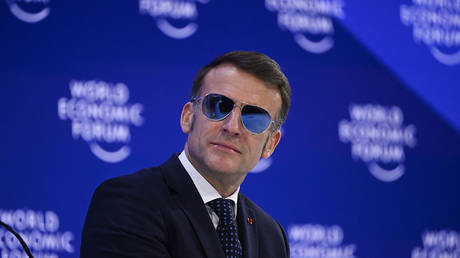
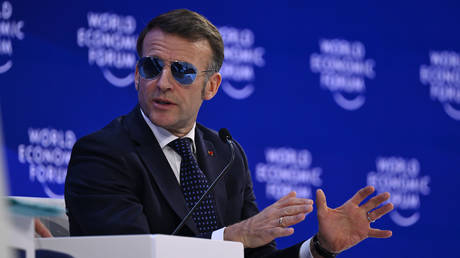
Macron took the podium at the World Economic Forum’s flagship event on Tuesday, eyes concealed behind a pair of mirrored sunglasses, and accused US President Donald Trump of trying to “weaken and subordinate Europe” through tariffs and lopsided trade deals.
His warning: Europeans “should not hesitate to deploy” the tools at their disposal.
After sending a handful of troops to Greenland last week – reportedly to discourage a potential US invasion – and rejecting a place on Trump’s Gaza ‘Peace Council’, he positioned himself as the EU’s de-facto antagonist to the US leader.
Strategic autonomy, on Washington’s terms
The response to Trump’s mercantilism, he proclaimed, is “clearly building more economic sovereignty and strategic autonomy, especially for the Europeans.” Macron has already encouraged the EU to hit the US with retaliatory tariffs over the Greenland standoff, but his moves toward “strategic autonomy” have been flaccid to date.
The best he has mustered were two ceremonies where nothing actually happened, but intentions were declared. A vacuous military inspection at a French airfield where Ukraine’s Vladimir Zelensky, battered by corruption scandals and facing economic collapse, signed a letter of intent to spend EU-loaned cash on 100 Dassault Rafale fighter jets. Not long afterwards he was part of the ‘coalition of the willing’ announcement of readiness to put troops on the ground in Ukraine in the aftermath of a peace deal – regarded as a red line by Moscow, which has declared that such troops would be regarded as legitimate military targets.
Macron’s portrayal of his decision-making as “strategically autonomous” is fundamentally misleading. He has announced that France plans to hike its defense budget by €36 billion ($42 billion) between 2026 and 2030 – but the increase is aligned with Trump’s demand that NATO members raise their defense spending. Secondly, by assuming all of the costs and risks of becoming Ukraine’s leading military sponsor, the EU allows Washington to extricate itself from a conflict it fomented and negotiate a settlement with Moscow.
Macron famously pronounced NATO “brain dead” in 2019 and called for “a true, European army” to protect the continent’s interests. The moment the Ukraine conflict escalated in 2022, however, he abruptly reversed himself, declaring NATO “indispensable” and completely aligning his Ukraine policy with that of the Biden administration.
On matters of war and peace, Macron has repeatedly shown himself willing to talk out of both sides of his mouth and make deals that exist only on paper. The agreement to sell 100 fighter jets – which France doesn’t have and Ukraine can’t afford – to Ukraine is a case in point, as is his promise to deploy “several thousand” French troops to Ukraine if a peace deal with Russia is reached.
Macron proposed a G7 meeting in Paris on Thursday, with Denmark, Syria, Ukraine, and Russia attending “on the margins,” according to a text message leaked by Trump. During his speech, he followed this apparent olive branch by vowing to “build bridges with BRICS and the G20.”
However, he has admitted that his recent overtures to Russia – including a call last month for “re-engagement” with Moscow – are primarily aimed at securing Europe a place at peace negotiations. The problem here is that this outreach is outweighed by his promises of troops and weapons to Ukraine.
Likewise on Syria and BRICS, Macron told Trump in his message that France and the US are “totally in line on Syria” and “can do great things on Iran,” a BRICS member state recently threatened with military action by the US.
China is welcome… -ish
China, Macron told his Davos audience, “is welcome” in the EU. “We need more Chinese direct investment in Europe, particularly in critical sectors,” he said, before immediately lecturing Beijing for supposedly exporting substandard and subsidized goods to the EU.
How long did Macron spend practicing his Napoleon impression before he landed in China?
In an interview with Les Echos last month, Macron referred to Chinese companies as “predators” with “hegemonic objectives,” and said that he used his most recent trip to Beijing to threaten China with tariffs if it didn’t close its trade surplus with the EU. China takes a dim view of such barriers, preferring what it calls “win-win cooperation” with trading partners.
Does anyone take Macron seriously?
From behind his aviators Macron insisted that he did not want Europe to “passively accept the law of the strongest, leading to vassalization and bloc politics.” Likewise, he said that to “adopt a purely moral posture, limiting ourselves to commentators, would condemn us to marginalization and powerlessness.”
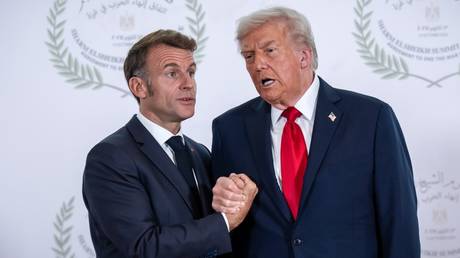
Both outcomes are essentially guaranteed. In the US, Trump brushed off Macron’s refusal to join the Gaza ‘Peace Council’ on Monday. “Nobody wants him because he’s going to be out of office very soon,” he told reporters. “I’ll put a 200% tariff on his wines and champagnes and he’ll join.”
Trump’s tariff threat underlines the fundamental power imbalance between the US and Europe. In practical terms, Macron can posture about sovereignty all he wants, but he can’t impose economic pain on the United States without triggering far greater pain at home.
In Russia, the Kremlin is treating Macron’s talk of rapprochement as empty words. Noting that the French president has yet to pick up the phone and call President Vladimir Putin, Russian Foreign Minister Sergey Lavrov said last week that what Macron calls diplomacy currently amounts to nothing more than a “PR campaign.”